
Wisconsin Arrest Records and Public Access
Yes, in most cases. Wisconsin statutes give the public a strong right to inspect and copy existing government records, and that reaches many police and booking files. Openness has limits, though. "Public" does not force a county to post every arrest online or open every field. Ask the authority that actually holds the record. The custodian weighs the material under the public-records statutes, confidentiality rules, and a public-interest balance. The outcome may be inspection, a copy, partial release with redactions, or a denial with written reasons. Sometimes the reply is simply that no record exists.
Name what you need first. A county jail booking entry, an arresting agency's incident report, a court docket, and a Wisconsin DOJ criminal-history entry are separate records. Was someone booked recently? The county jail is usually the first stop for current custody. A roster may drop the booking after release. For what happened in court, search the case record and read its disposition.
Wisconsin Public-Records Rules
Wis. Stat. § 19.31 is blunt about intent. It declares a strong public interest in the fullest information about government affairs. That law must be read in favor of access. Sections 19.32 and 19.35 define what a record is. They also set out the right to inspect or copy one. Section 19.36 lists statutory limits. Section 19.37 provides enforcement remedies. Because the statutes cover visual and electronic material too, a booking photo can ride along in a request. The agency still screens the content, the person's age, and any protected information before releasing anything.
The Wisconsin Department of Justice's Public Records Law Guide offers practical direction. A request should reasonably describe an existing record and reach the proper authority. No fixed day count applies statewide. A public authority must respond as soon as practicable and without delay. Fees cover actual, necessary, and direct costs of locating, reproducing, processing, or mailing. Inspection itself generally carries no separate charge. Prepayment may be requested when an estimate runs high. The state sets no flat fee for a booking photo.
The statutes open doors to records an authority already holds. They do not mandate a web roster. An agency need not build a new "statewide arrest report" from scattered systems either. Redactions are allowed. Medical details, juvenile information, victim or witness identifiers, confidential sources, and anything the law shields can all be withheld. A denial should state its basis. Ask which record was withheld and how the custodian applied the law.
Match the source to the question. A jail holds the booking entry and identification photo. A police department keeps the incident report, while a court holds the filings and disposition. DOJ maintains a separate criminal-history repository. So one source rarely answers everything. A public arrest record rarely tells the whole story. It does not automatically include a complete case history, a current custody answer, or an online photograph.
Why Wisconsin Booking Photos Differ
Wisconsin has no enacted mugshot-removal statute. Nothing on the books bars a private booking-photo publisher. Such a site may charge to take down a listing. That is a narrow gap, though. Consumer rules and other laws may still reach such conduct. The public-records law keeps governing records held by a government authority. It hands private publishers no license to misstate a record. Nor does it make every old copy permanent.
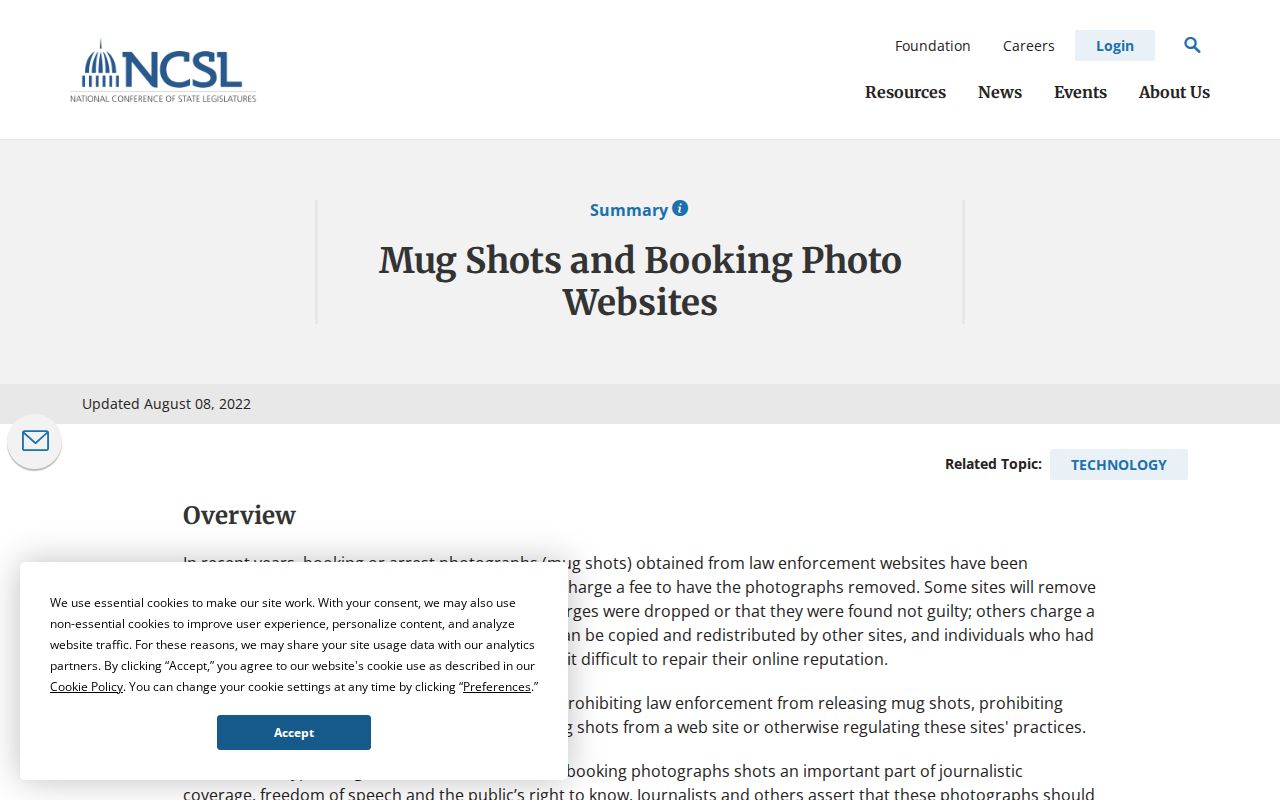
The National Conference of State Legislatures gives the history. It lists Wisconsin Assembly Bill 258 and Senate Bill 184 as failed proposals. Both were introduced in 2015. They proposed fee-free removal of online criminal-record information. History, not current law. Wisconsin thus lacks an enacted removal statute with a set removal deadline. So a site should not promise that. An accurate private page need not disappear automatically after a court event.
The NCSL survey records the failed status and the policy backdrop. It remains a secondary source. Do not stretch its entry into a claim about every possible Wisconsin remedy.
Wisconsin courts lean toward public access, not private-site takedowns. Two Supreme Court cases frame the issue. In Newspapers, Inc. v. Breier, the Court held police arrest and blotter records open to the public and found no general constitutional privacy bar to inspection. That ruling came in 1979. Later, in Zellner v. Cedarburg, 2007 WI 53, the Court kept its case-by-case approach, weighing the access interest against a stronger policy for withholding. Embarrassment alone never wins that balance. Neither case forces a county to publish an online roster.
Wisconsin Record Searches by Source
An empty booking page is not a dead end. It is one stop on a longer search path. A released person may have dropped off a current-custody list, and a city arrest can still be booked in a county jail. Some cases take time to be filed. A DOC profile, meanwhile, speaks to state custody or supervision rather than a county booking. Each source answers one question, so treat the official search as a sequence of checks with a clear question at every stop.
- Identify the county, approximate booking date, and arresting agency from a reliable source.
- Check the county sheriff or jail roster and note whether it is current custody, a dated booking list, or a multi-day report.
- If the page does not show the event, contact the records custodian for an existing booking or arrest record.
- Use Wisconsin Circuit Court Access to check filed case events and disposition; do not treat it as a live roster or warrant clearance.
- Use the DOC locator, BOP locator, or ICE locator only for their separate custody systems.
Two companion pages help fill the picture. The Wisconsin photo landscape piece explains a county-level split. One county posts images while another keeps the public view text-only. The Wisconsin State Patrol arrest records page covers that agency's publications and its request path. Still, neither replaces the county custodian when the question is where a recent booking sits.
Wisconsin County Record Differences
Wisconsin's 72 counties run different jail software, publishing habits, and update schedules. The differences show up fast. Waukesha updates its current list hourly and keeps it text-first. Barron splits its current roster from a seven-day booking page. Photos appear on the current view. Columbia's booking PDF says it is updated "time permitting" and is not a current-custody list. Crawford's inmate page carries a morning "as of" snapshot. These examples are not a ranking, and they can change.
Elsewhere the options vary just as much. Some counties offer an inmate locator, while others post a dated PDF. Some have no public name-level roster at all. A missing public page does not mean a missing record. Some sources list people only while in custody. Booking reports can keep released people through a date window. An empty photo box does not prove the agency lacks an identification image. Time limits matter as much as county labels.
Before trusting a result, read the title, date, scope note, and custody status on the official page. Vendor portals change, so check the county's current instructions. A jail roster answers a current-custody question. A records request suits an older booking or a copy of a specific report.
Correction, Sealing, and Expungement
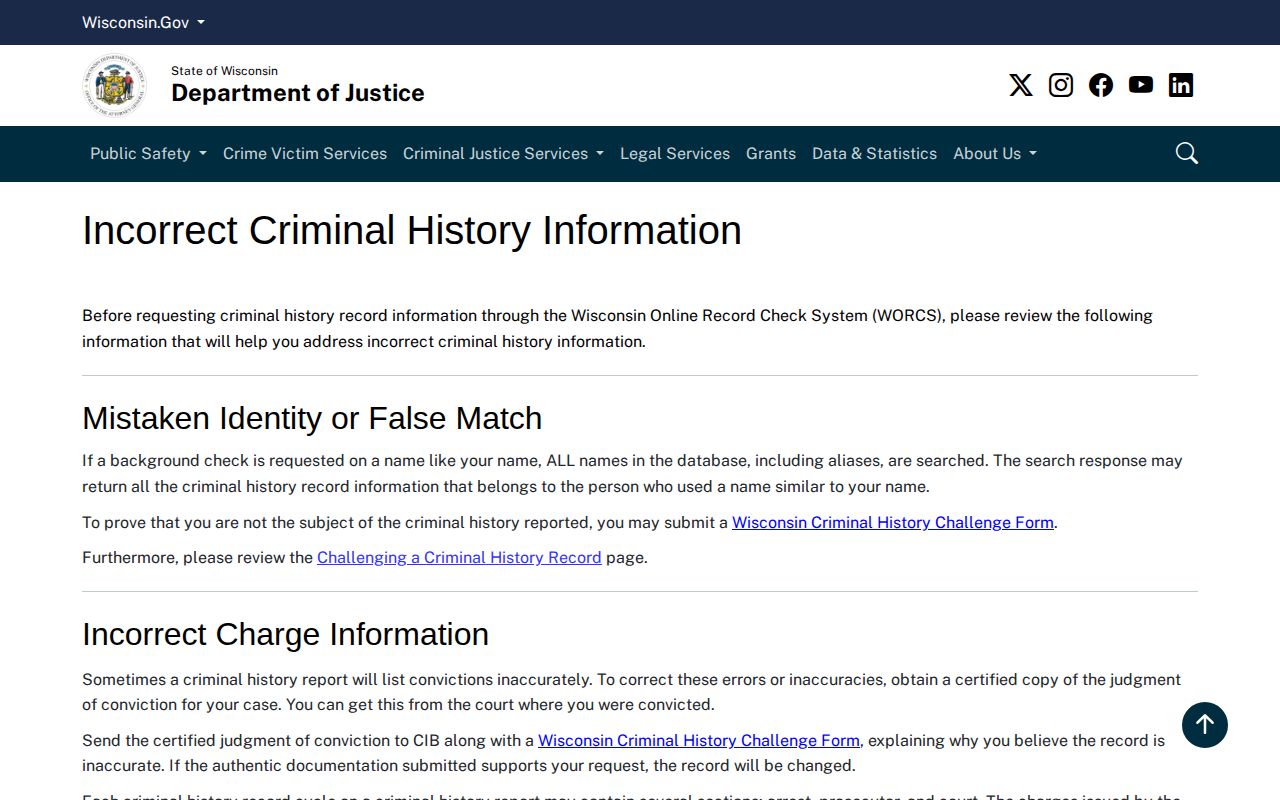
Start any correction with the source that made the error. Save the exact URL or booking number. Name the wrong field and attach an official document that supports the fix. Errors in the state criminal-history repository follow a separate track. That track runs through Wisconsin DOJ's Crime Information Bureau. Its instructions cover eligible arrests. These include matters with no charge, a dismissal, or an acquittal. Fingerprints and supporting court papers are generally required. The process carries no fee. It does not erase the county jail's record or a private site's copy. Information tied to a conviction stays in the state record. This applies even when a court file was expunged.
The DOJ page also explains how to challenge incorrect criminal-history information. It points to where the correction request belongs. That page covers the state repository, not county bookings.
Adult expungement lives at Wis. Stat. § 973.015. Eligibility turns on the offense, the sentence, the court's decision, timing, and compliance. It is not a general deletion order. Juvenile records follow separate rules under ch. 938, including confidentiality and expungement provisions. Get the actual order. Identify the record it covers. Then ask each custodian what changed, and never assume an adult process fits a juvenile case or that a corrected court docket updates a county roster on its own.
| Route | Practical effect | Limit to keep in view |
|---|---|---|
| County or arresting-agency correction | May correct that authority’s record or explain a redaction | Other custodians may keep separate copies |
| Adult expunction | May affect the specific court record covered by an eligible order | Does not automatically erase every jail or private webpage copy |
| Juvenile expunction or confidentiality | Uses the separate juvenile law and record path | Juvenile records must not be treated as adult public roster material |
| DOJ criminal-history correction | Can address eligible information in the state repository | Does not itself remove a county booking image or aggregator page |
| Publisher or search-index request | May correct an item under the publisher’s policy or refresh an outdated search result | Each service decides its own process; a request is not a court order |
Wisconsin Publisher Opt-Out Paths
Third-party publishers offer their own removal paths. These are voluntary site policies. They are not rights created by Wisconsin law. BustedNewspaper runs a form that wants the listing's exact web address. It also asks for your contact details, a reason, and supporting legal papers. Sealed, expunged, dismissed, not-guilty, and duplicate listings are among the situations it names. Expect a five-to-ten-day review window. That estimate comes from the publisher, not from any government deadline.
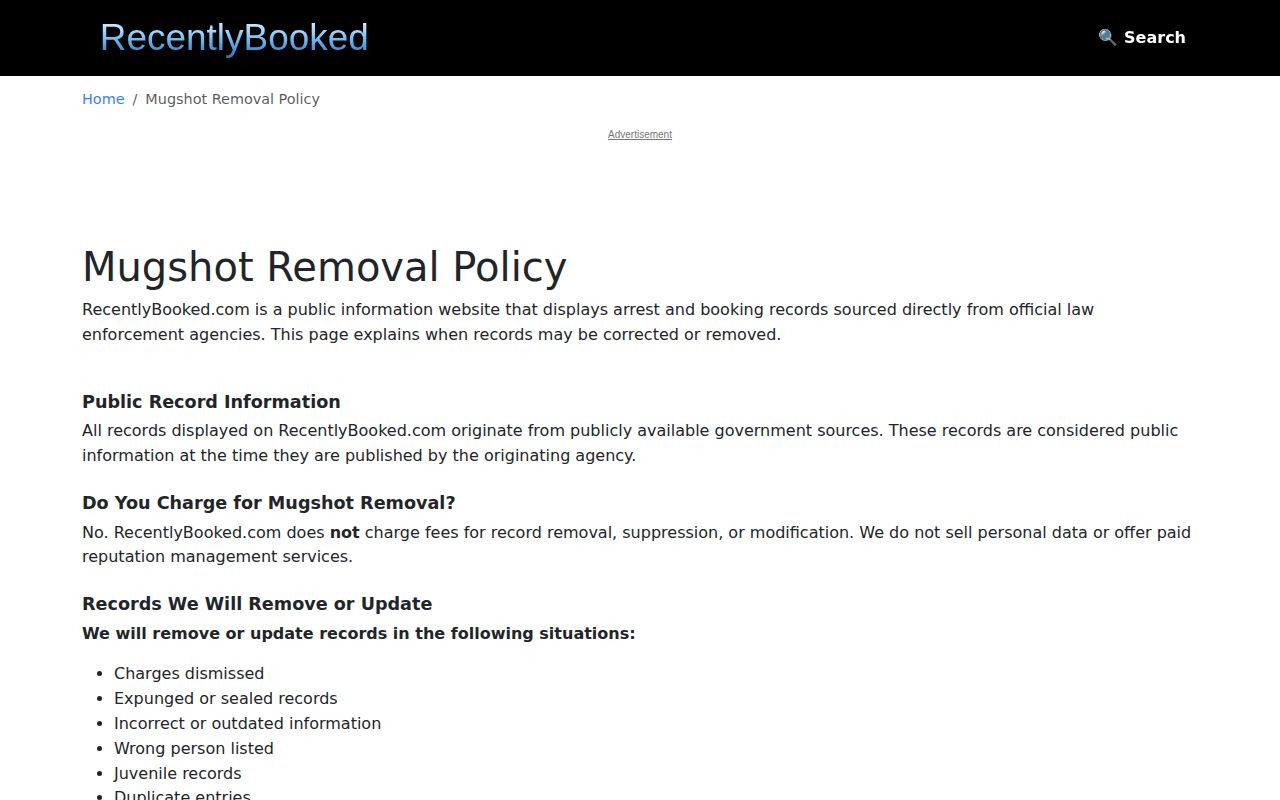
RecentlyBooked takes a similar approach. It charges nothing to remove, suppress, or modify an entry. Its accepted cases include dismissed, sealed, expunged, incorrect, wrong-person, juvenile, and duplicate material. You supply the exact page, the name, the date, and the county. Add a reason and any relevant legal paper. Each free request still passes its verification process.
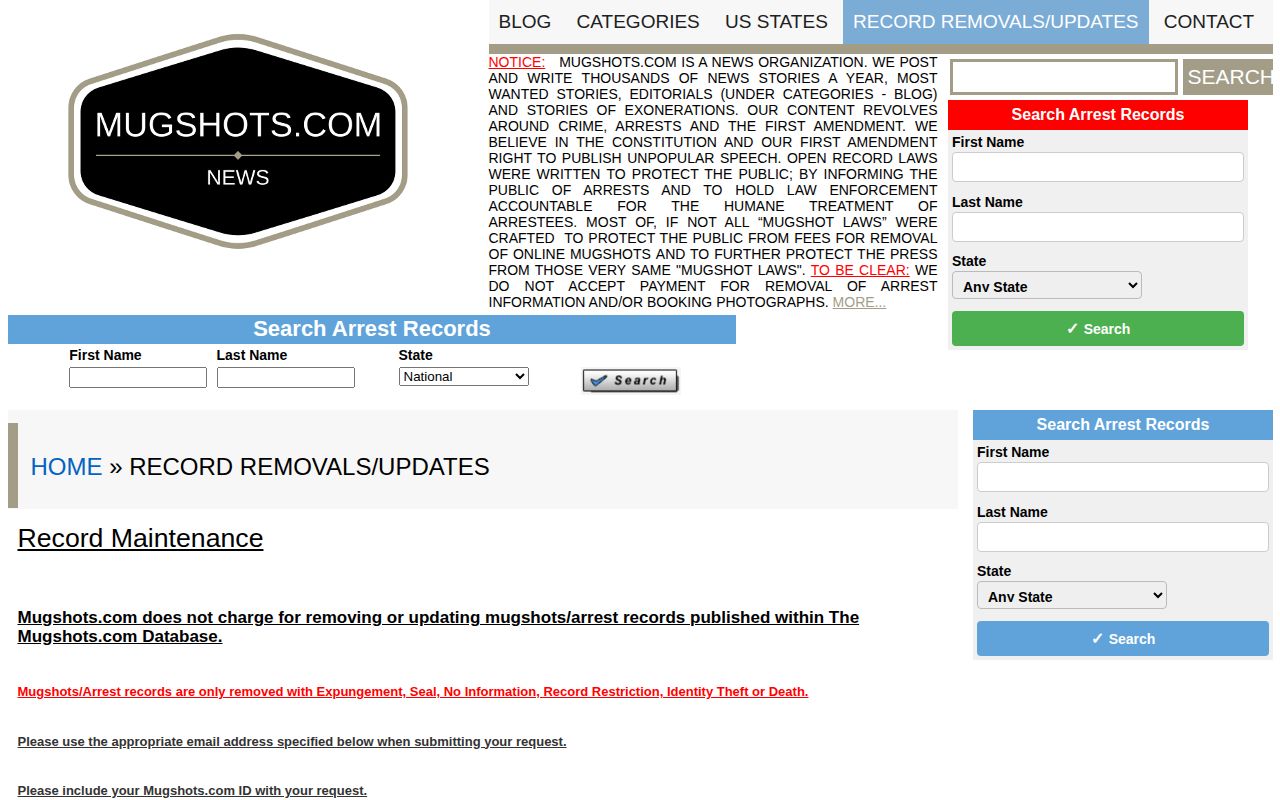
The Mugshots.com record-maintenance policy is free and documentation-based. It separates removal for certain sealed or expunged records from updates tied to favorable outcomes. You must cite its record identifier and send legible court paperwork. Mugshots.zone hosts a county-level form. It may request a URL, a reason, and documents, and its host can change. Check the live form first. Arrests.org lists no clear statewide free opt-out for Wisconsin. None of these publisher promises creates a legal entitlement in the state.
The RecentlyBooked removal policy covers corrections as well as takedowns. It charges nothing and lists the record types it may update.
Never pay a stranger just to make an old booking photo vanish. A payment demand proves nothing. Removal is not guaranteed either. Save a copy of the page first, date and all. Then ask the originating custodian to fix the source if it is wrong. Stick to a publisher's own current free process. Coercive requests or records with legal consequences call for a Wisconsin attorney.
Search engines can lag behind the source. Wait until the source page is fixed. Only then use an outdated-content request. A cache refresh is not an expunged government record.
Wisconsin Arrest-Record Limits
Juvenile records sit under special rules. Wis. Stat. § 938.396 governs juvenile records, and § 938.78 adds confidentiality rules for children's records. An adult booking page never licenses naming a minor. If a roster omits something, don't guess why. Ask the proper juvenile court or authority about its lawful process. Never publish a child's name or photo from an unofficial source.
Other limits reach further. Victim and witness details, medical and mental-health material, confidential sources, open investigations, personal identifiers, and federally protected records can all be withheld. The custodian must weigh each record and explain any denial or redaction. A photo can be treated differently from a brief roster entry because content and context differ.
When Wisconsin Records Age
Retention starts with Wis. Stat. § 19.21. The Wisconsin Public Records Board's County and Related Records General Records Schedule is a statewide reference, but a county must adopt it first. County mug shots and booking records appear as permanent series. Jail registers run one month past the event. They then transfer to the Wisconsin Historical Society. Arrest records last event plus eight years before confidential destruction. None of that forces a live public roster.
Schedules can differ. A pending request, audit, lawsuit, or legal hold can halt routine destruction. Permanent means recordkeeping, not posting. A county arrest record may stay with the sheriff, move to an archive, be destroyed under an approved schedule, or be restricted by another law. Ask the custodian which schedule applies.
Wisconsin's record law and its case decisions favor meaningful access. Photo rules stay record-specific. There is no uniform mandate to post arrest photos online.