
Wisconsin Recent Arrests
No single state roster collects every booking in Wisconsin. Each county runs its own system, and the differences add up fast. One sheriff posts a current-custody list. Another publishes a dated booking file or a searchable vendor portal. Some share arrest details only through press releases. A few put no public name list online at all. "Recent" therefore shifts its meaning from county to county in practice.
The type of record shapes what you learn. A current inmate list shows who is in custody at a given moment. A booking report covers a set date range and may include people already released. A police blotter logs arrests in order. It can leave out details kept in a separate file.
Start with where the booking occurred, not where a person lives. City police and State Patrol arrests take different paths. Some land in a county jail, a municipal facility, or a citation path instead. Someone released before a roster refresh will not appear. A person can also be moved to another facility. Some are held on a warrant matter rather than a new charge. A missing name on any roster never proves no arrest occurred. Charges themselves can change or be dropped later.
County habits show why the label matters. Waukesha County refreshes its inmate list hourly. Barron County keeps a current roster apart from a seven-day booking page. Columbia County updates its booking file "time permitting." None of these share one clock, retention window, or photo policy. Check each source's own date note before trusting an entry as current.
Wisconsin County Booking Sources
Routing by county is the practical first move. Wisconsin law applies statewide. Every sheriff still picks a public page style, its own search fields, refresh pattern, and photo display. The statewide County Directory routes to each county's recent-arrests site, where local sources and city coverage sit together.
Geography usually points the way. A Green Bay booking leads to Brown County records. A Madison booking leads to Dane County records. Neither shortcut is perfect, since events inside a city can fall to a different agency. Ask who took custody. That matters when a location crosses a county line or when someone was cited and released instead of booked. The booking county, the arresting agency, and the court county do not always match.
The Wisconsin Counties Association county listing confirms county names and seats. Treat it as a routing aid, not an arrest database.
Once the county is known, go to its sheriff or jail source. There you can confirm the booking and check current custody status.
Same-Day Wisconsin Arrests
A same-day search needs two things: a county and a source with a clear window. Some counties run a current-custody page. Others post a morning extraction. Some use a multi-day booking document that staff update when time allows. Each format has blind spots. A current list can miss someone. That person may be released before the next refresh. A dated PDF can still show a person no longer held. No common statewide clock makes every result a true rolling 24-hour list.
Read the county's own "as of" note first. If a very recent booking is not visible, call the jail or records unit. Wisconsin VINE tracks county custody and release notices, though it remains a separate custody system.
| Window | What it means in Wisconsin | Statewide treatment |
|---|---|---|
| Same-day or current view | A county current-custody page, a dated morning list, or a short booking window with its own refresh pattern | Arrests Last 24 Hours compares these systems and explains the lag checks |
| Multi-day blotter or log | A dated booking PDF, several-day list, news blotter, or an archive when the county keeps one | Police Blotter covers the wider window, news sources, and records request path |
Rosters lag. They also drop names after release. For a time-sensitive custody question, confirm with the receiving jail, since a blank search never proves no arrest took place.
Where Wisconsin Arrests Appear
Different records answer different questions. The arresting agency holds the incident report or citation. The jail holds the booking entry and may publish a roster or booking file. A court case carries the later filings and outcome. A strong statewide search starts with the official record holder, then checks each next layer only for what it can actually answer.
| Source | What it can show | Limit |
|---|---|---|
| County sheriff or jail | Current custody, booking date, identifiers, alleged charges, and sometimes a booking photo | Fields, photos, and refresh times vary by county |
| Arresting agency | Existing incident, citation, or arrest records | A release decision or an online news item is not a complete jail roster |
| Wisconsin circuit-court case search | Filed court events and later case outcomes where available | It is not a live booking feed or warrant clearance |
| Wisconsin DOC | Public profiles for people sentenced to state prison or under DOC custody or supervision | It is not a county-jail arrest list |
| News releases and blotters | Selected events, enforcement summaries, and public safety notices | Selective coverage, not a complete list of arrests |
Wisconsin has no single public list of arrests by name. The State Patrol posts enforcement news through WisDOT, though nothing at the name level. For court records, the place to look is the Wisconsin Court System case search. CCAP covers circuit courts across the state. One gap exists, though. Walworth County sits outside the normal coverage. So a search that comes back empty could mean one of several things. It might point to a sealed record, restricted access, or simply timing.
Plenty of unofficial sites surface when you search a name. BustedNewspaper Wisconsin, RecentlyBooked Wisconsin, Mugshots.com Wisconsin, Arrests.org Wisconsin, and county-hosted Mugshots.zone pages are all on that list. Every one of them republishes booking data or indexes it. Entries can lag, repeat, or miss the mark. Treat them as leads toward the county or court record that started it all.
One more caveat deserves mention. The Mugshots.com Wisconsin index is a commercial site, not an agency record. Its real value is nudging you back to official sources.
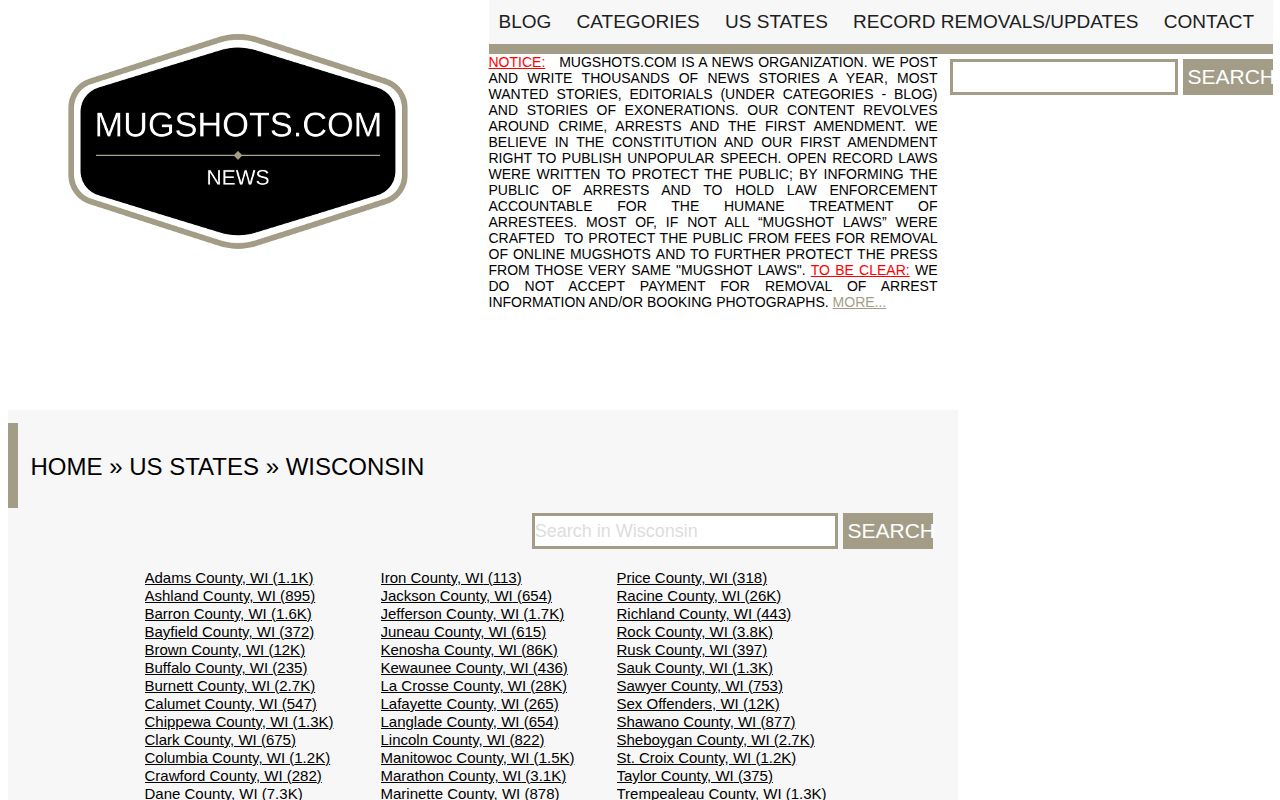
Aggregator pages shift from day to day. Some load with nothing but search tools and county links. The RecentlyBooked Wisconsin page remains third-party either way. A challenge screen proves nothing. So does a blank page. The unofficial Mugshots.zone description helps explain the county-hosted layout, and a listing that stays online says nothing about whether a person is still in custody.
Treat a copied listing as a lead. Check that county's own record and any later court entry before relying on it.
Wisconsin Arrest Record Fields
One arrest touches several record keepers. The arresting agency may hold an incident report, citation, dispatch entry, fingerprints, or probable-cause material. The receiving jail builds the booking record and register entry. It may add an identification photo. A clerk or prosecutor holds the later court material. Wisconsin's Department of Justice keeps a separate criminal-history repository. No single layer holds every field. Protected details can be withheld or redacted.
The fields below appear when an agency records them and the law allows release. A roster is a brief view, not the full booking packet. A name match alone confirms little, so compare several fields and ask the custodian when the record truly matters.
| Record field | What it may show |
|---|---|
| Name and booking identifier | The person and the jail’s event or booking number |
| Booking date and agency | When the jail processed the event and which agency brought the person in |
| Reason or charge label | The arrest basis or charge as entered at booking, which can differ from a later court filing |
| Custody and release status | Whether the jail page currently lists the person and, when published, a release or transfer event |
| Bond or court information | Bond, court date, or case number when the jail’s public interface includes those fields |
| Identification photo | A booking image held by the agency, if its policy and the record-specific release review allow it |
The DOC Offender Locator is a separate record layer. Its public profile may carry a name, a DOC or PIOC identifier, an institution or location, and sentence or release-status fields. Those details track state custody or supervision. A DOC profile never replaces the county booking entry. Do not expect a downloadable photo for every result, since the locator makes no such promise.
Wisconsin Booking Photos
Wisconsin sets no uniform rule for publishing booking photos. Sheriffs choose their own approach. Some counties post text-only rosters. Others run portals with a photo field, show photos for only some records, or publish no name-level roster at all. Barron's current roster showed booking photos. Waukesha's list and Columbia's booking PDF stayed text-first. Those pages describe one moment in time, not a standing promise about design or every record.
Each photo request passes through a custodian's judgment. Wis. Stat. §§ 19.31–19.37, confidentiality rules, juvenile limits, court orders, and the public-interest balance all shape the answer. The Wisconsin DOC keeps identification photos for institutional use. Its public locator does not promise an image for every profile. No official source backs a statewide photo gallery.
Third-party sites create their own problems. One may keep an old booking image after the county roster drops a released person. A commercial index can go stale, mislabel a county, omit a later dismissal, or attach the wrong person to a record. Open the source itself when you must. Then return to the sheriff, jail, or court to verify the record and its current status.
Wisconsin Public-Records Law
Wisconsin leans hard toward open government. Wis. Stat. § 19.31 declares a strong public interest in how government works. Sections 19.32 through 19.37 define records, set access rules, name limits, and add an enforcement path. Under § 19.35, anyone may ask an authority to inspect or copy an existing record. That right creates no duty to post bookings online. The custodian weighs the specific record, statutory limits, confidentiality, and the public interest before releasing anything. A booking photo counts as a record. Even so, an office may withhold or redact it for a valid reason.
Removal fees are a different question. Wisconsin has no enacted law barring a publisher from charging to take down a booking photo. Two bills aimed at that failed. NCSL lists 2015 Assembly Bill 258 and Senate Bill 184 as dead proposals, not law. Nor does a public-records right bind a private site. The law cannot force one to erase every copy. For a disputed source record, contact the government custodian. For an eligible criminal-history error at the state level, Wisconsin DOJ offers a separate correction process. An expunction, correction, or court order can back a publisher request. It still will not clear every private copy or search result by itself.
Adult expunction runs on Wis. Stat. § 973.015. Eligibility turns on the offense, the sentence, the court's decision, timing, and full compliance. Juvenile matters follow chapter 938 instead. Do not apply the adult process to a juvenile case. The DOJ arrest-information path carries its own rules, usually asks for fingerprints and court papers, and reaches the state repository, not every county or publisher record.
| Path | What it can change | What it does not guarantee |
|---|---|---|
| Request or correct the source record | A county or agency may release, redact, correct, or explain its own existing record | It does not control a separate court file or private copy |
| Adult expunction or juvenile process | A court process may affect eligible records under the law that applies to the person and case | It is not an automatic removal command for every webpage |
| Wisconsin DOJ correction | The Crime Information Bureau may correct eligible arrest information in the state repository | It does not erase a county booking page or a publisher’s copy |
| Publisher correction or opt-out | Some publishers offer free routes for documented errors, dismissals, or eligible court outcomes | Policies differ, and a request does not establish a legal right to remove an accurate item |
Some publishers do offer free removal. BustedNewspaper, RecentlyBooked, Mugshots.com, and the Mugshots.zone contact form accept documented requests at no charge. Those are company policies, not Wisconsin law. Arrests.org's Wisconsin page shows no statewide free opt-out. When you write, send the exact listing URL and the papers that show the correction. Skip unrelated sensitive material. A payment demand alone proves nothing is owed. Save the page, read the publisher's current written policy, and get legal advice if the request feels coercive or the record is wrong.
Expungement fixes only the records it covers, leaving copies with other custodians, publishers, and search indexes in place.
Request Wisconsin Arrest Records
Sometimes the jail roster is missing. Or the person was released. Sometimes the page just omits a field. In any of those cases, ask the agency that made or keeps the record. Wisconsin's public-records law allows inspection and copying. Statutory limits and the common-law balancing test still apply. Send the request to the right authority and ask for an existing record. No office has to create a new statewide arrest list. Nor must it merge unrelated files into one report. WisDOT offers one agency-specific example. Its State Patrol open-records page accepts requests for records that division holds. But it is not a statewide portal for county bookings.
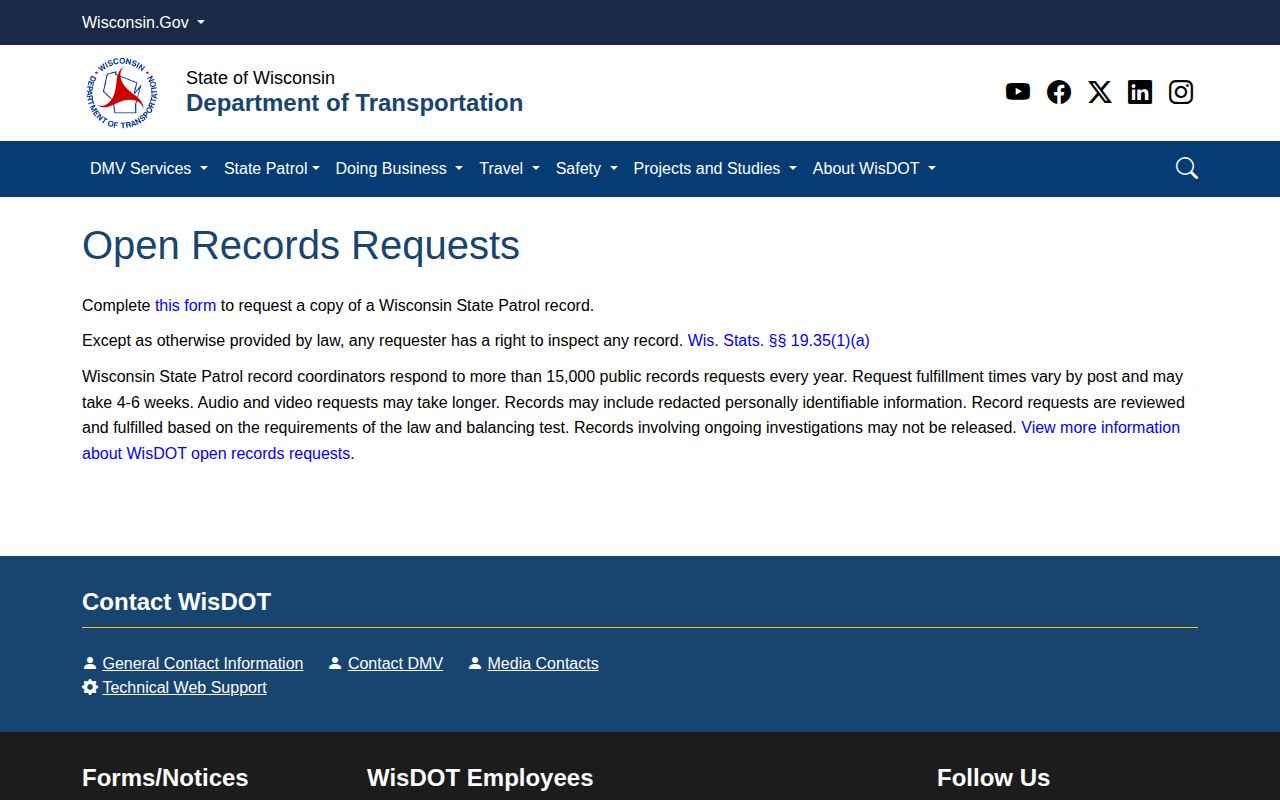
The live page gives the route and timing estimate. Audio and video requests can take longer. Confirm the current instructions there. Ask the record-holding authority for a direct-cost estimate too. A good request names the date range, place, agency, and record type. Under Wis. Stat. § 19.35, an authority may charge actual, necessary, direct costs allowed by law to locate, reproduce, process, or deliver records. Inspection itself carries no separate fee. Wisconsin sets no statewide flat mugshot charge. Get the estimate before agreeing to a pricey format. Authorities must respond as soon as practicable and without delay. No fixed response-day count applies statewide.
For a county booking or photo, name the county and contact that sheriff or jail records custodian. The county directory routes you to the right county site to confirm its records path. For an arresting-agency report, send the request to that agency, even if another jail took custody. Errors in the state criminal-history repository go through Wisconsin DOJ's separate correction process, which does not erase a county record or every private copy.
- Write down the event date, location, arresting agency, and likely booking county.
- Ask for specific existing records, such as the booking entry, arrest report, or releasable identification photo.
- State a preferred delivery method and ask for an estimate of allowable direct costs.
- Keep the request and response. If material is withheld, ask which record was withheld and the legal basis.
Skip blanket demands for everything about a person. A defined date and record type works better. Custodians may redact juvenile, medical, victim, witness, confidential-source, or active-investigation material. A partial release does not mean the rest of the file is gone.
Wisconsin Warrants and Wanted Lists
Wisconsin keeps no single statewide roster of wanted people through its Department of Justice. What the state DOJ's Division of Criminal Investigation offers instead is a look at its investigations and the Crime Alert Network. That is not a fugitive database. Wanted notices in Wisconsin mostly live at a lower level. County sheriffs and courts post their own, and federal district offices carry selected fugitives profiled by the U.S. Marshals. Notices shift over time. One can expire, get corrected, or leave details out for safety reasons. For a live warrant, ask the issuing court or the law-enforcement agency behind it.
Federal sources fill part of the gap. The U.S. Marshals profiled fugitives page and the Western District of Wisconsin office are the official starting points there. News coverage adds another layer. The FOX6 Most Wanted series tracks notable cases, but it is journalism, not a warrant search. A story can go stale the moment a fugitive's status changes. Check the date, then confirm the underlying notice before acting. WisDOT's State Patrol newsroom shows the same pattern from the state side: campaign news and regional enforcement items, never a complete wanted list or a public arrest log with names.
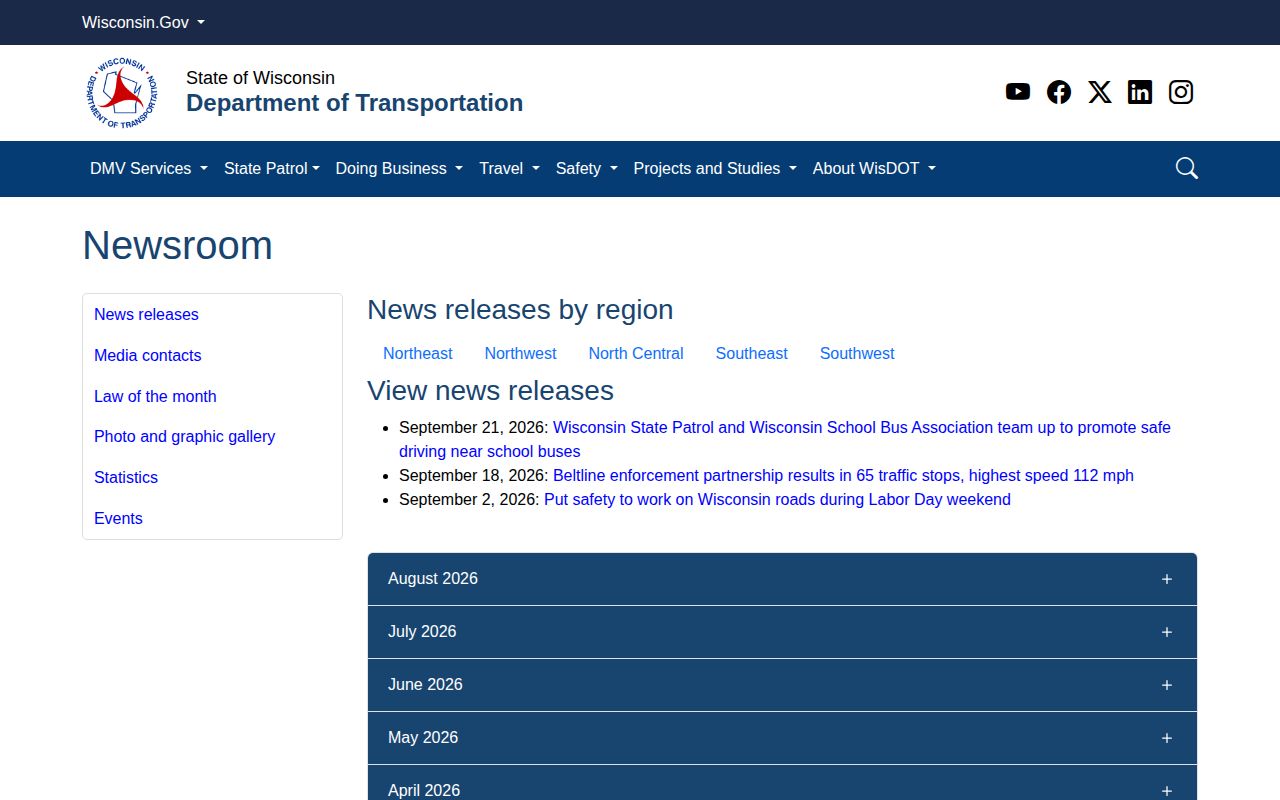
The safest warrant check goes through the clerk or sheriff who issued it. Ask them to confirm the case and the next lawful step. For a warrant in your own name, an attorney can contact the court. The lawyer can then work toward a resolution. Spot someone who is wanted? Do not approach, follow, or post a private address. Call 911 if there is immediate danger. Otherwise, send a tip through the route printed on the notice.
Never try to detain someone found on a booking list. Send a tip to the agency named in the notice instead.
The DOC runs a service called NOTIS. It is free, but you must enroll. It covers only eligible custody and supervision events, including certain absconder events. There is no public statewide absconder list behind it. A supervision alert and a fresh county booking are separate events. The Wisconsin DOC NOTIS page explains enrollment and which events can trigger a notice. Each type belongs to its own official system.
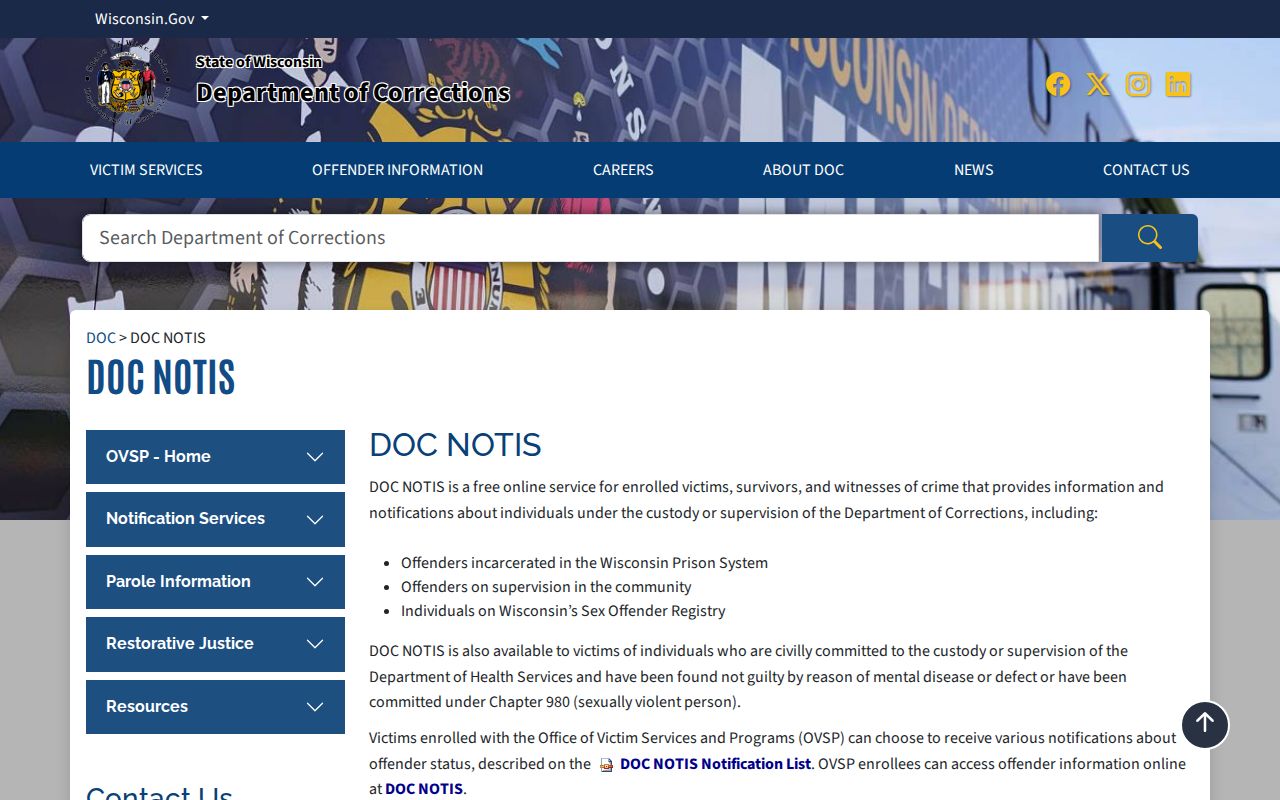
Let NOTIS handle the DOC events it covers. For a separate arrest or warrant record, check the county jail or law-enforcement agency directly.
After a Wisconsin Arrest
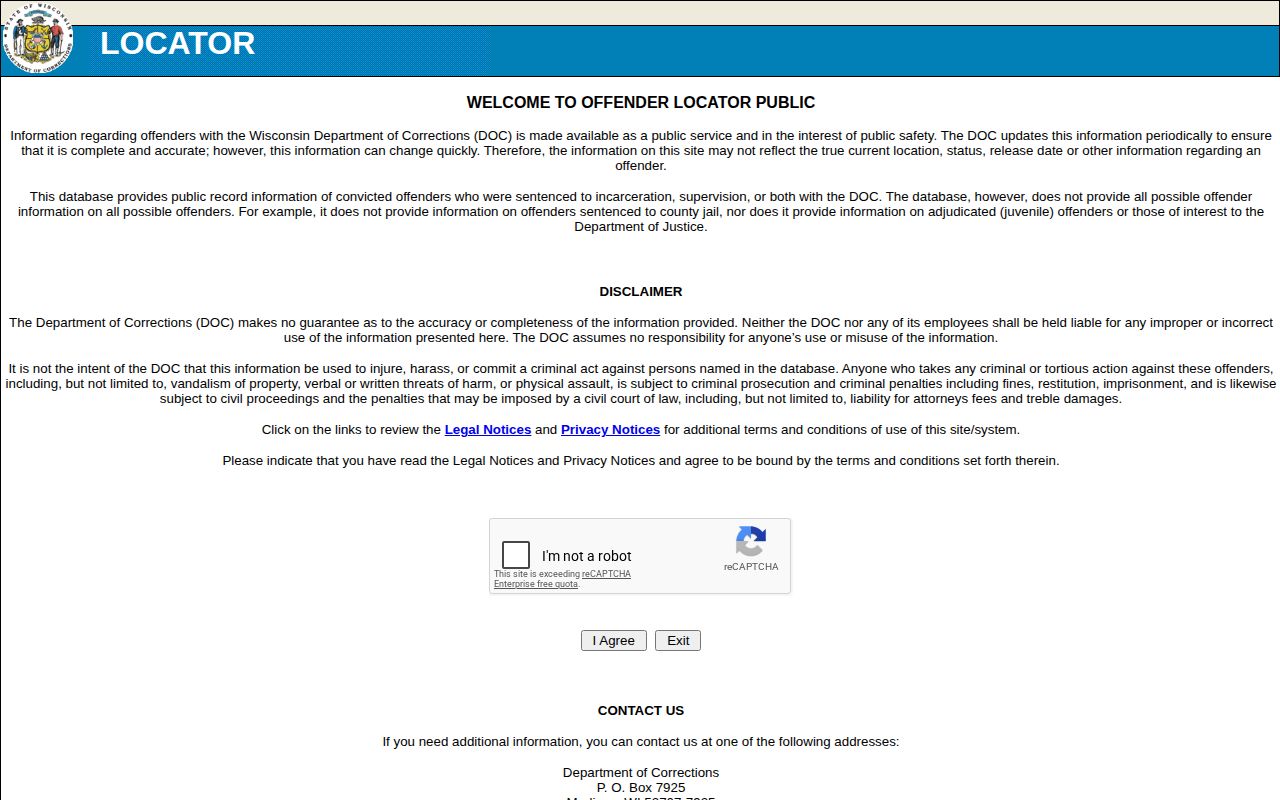
A booking entry records what the arresting agency wrote down at intake. Nothing more. A prosecutor can file charges different from the ones listed. A court can dismiss or reduce them. The disposition is the court's outcome. Match the court record to the right person. A jail label alone cannot sort out every mix-up like that. Wisconsin's DOC Offender Locator serves a different population. It covers people sentenced to state prison or held under DOC custody or supervision. It misses many arrests entirely. A person may instead sit in a county jail, a municipal facility, or federal custody. Or the person may already be released. The public screen shows identifying and status fields, though a downloadable photo is not guaranteed. The Wisconsin DOC Offender Locator opens with a notice about its scope and limits. Treat it as a post-sentencing and supervision source, not a county booking roster.
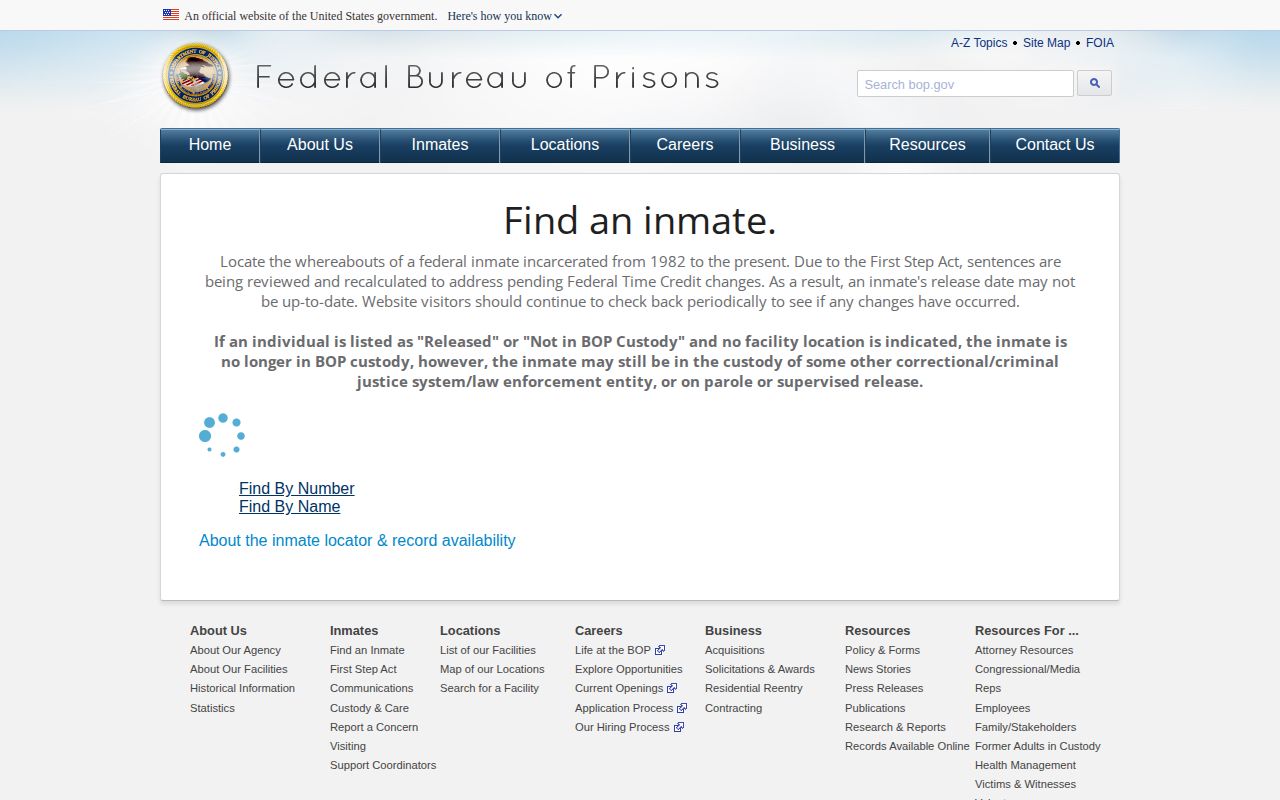
Federal sentences follow a different path. The Federal Bureau of Prisons locator tracks federally sentenced custody. No public mugshot gallery is attached. Immigration detention sits apart from any state criminal case. The ICE Online Detainee Locator runs on its own search fields and custody records. A blank result in either system says nothing about a Wisconsin county booking.
Booking data is a starting point, not an ending. Verify identity, custody, and the court disposition with the office that holds each record.
Wisconsin Arrest Logs
Not every Wisconsin arrest record is the same record. A multi-day booking PDF answers one question. A police blotter answers another. A news release and a current inmate list each answer a different one. Some counties keep a short display window or an archive. Others swap in a fresh file or lean on a vendor portal. The State Patrol newsroom reports selected enforcement work and campaign results, not every name-level arrest. Wisconsin Supreme Court decisions recognize public access to arrest and blotter records. Still, no agency is required to build a searchable public feed.
Work from the date and scope printed on the actual page. An older event may drop offline. Request the existing record from the agency that created it. A later WCCA case can confirm disposition. But it cannot replace the arrest report or a full archive. Police Blotter maps the wider statewide publication landscape.
Wisconsin Booking Archives
A missing roster entry does not mean a booking record is gone. Wisconsin's County General Records Schedule sets the rules. It keeps county mug shots and booking records on a permanent series. Jail inmate registers are held for the event plus one month. They then move to the Wisconsin Historical Society. Arrest records stay for the event plus eight years before confidential destruction. Counties that adopted the statewide schedule follow these rules. Others may use a different approved schedule. So a public webpage can vanish while the custodian still holds the record. A series may also sit in an archive instead.
Holds can stretch these windows. A legal hold, pending request, audit, or litigation may keep a record past its scheduled end. "Permanent" only describes retention, too. It never promises that a photo gets posted online. Nor does it promise that every historic image is open to viewing. The safest question goes to the sheriff's records custodian or county clerk. Which schedule applies? Is the record held locally, transferred, destroyed, sealed, or restricted?
Older materials live elsewhere. The Wisconsin Historical Society Area Research Centers serve as regional access points for archived county records. A catalog search there may surface a county series, collection, or call number. An archive entry is still not a current arrest lookup. Treat it as history rather than a live roster. Handle old names and photographs as archival records, plain and simple.